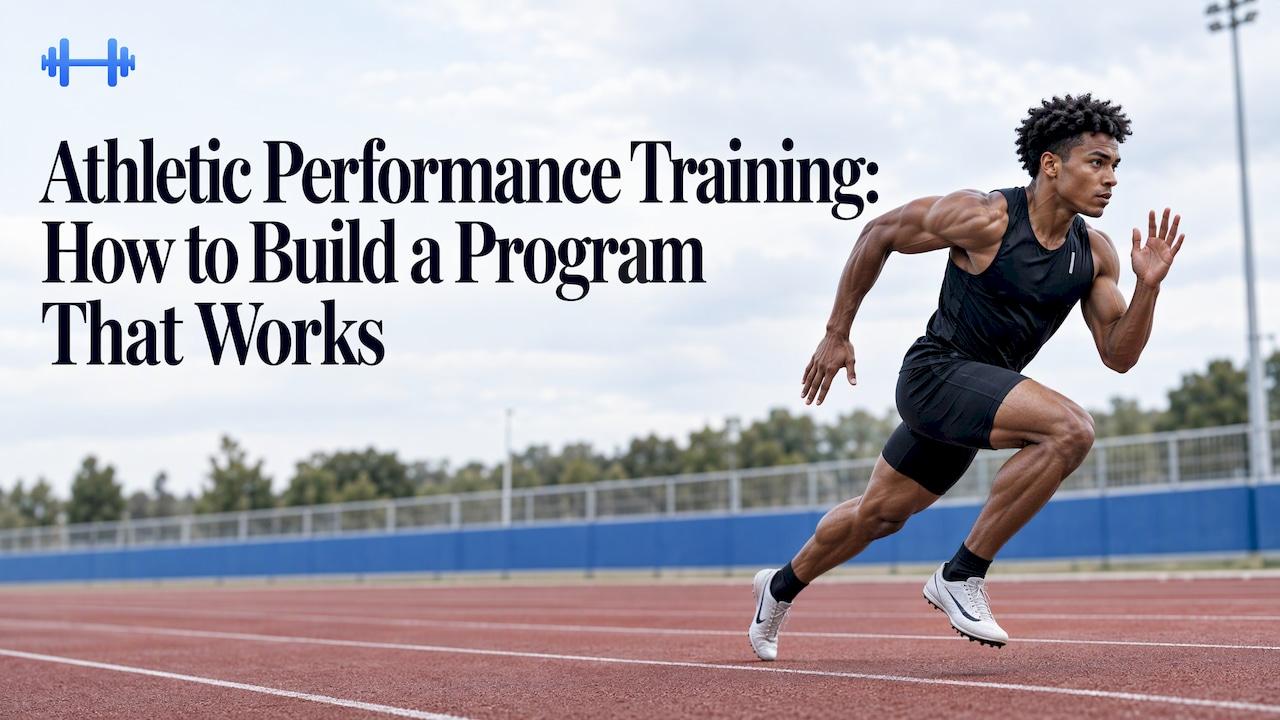
Athletic performance training is the planned development of the physical qualities your sport demands: strength, power, speed, agility, endurance and the ability to recover and repeat. It works when you test where you are, pick a target, train a few qualities at a time in a set order, raise the load in small steps and record every session so you can adjust. The hard part is rarely the exercises. It is keeping the plan, the logs and the feedback in one place. That is why we built GymCoach to hold programs, workout tracking and coach-athlete messaging together, instead of leaving them scattered across group chats and spreadsheets.
TL;DR
- Start with one specific, measurable goal and a baseline test, then choose exercises that serve that goal.
- Train strength 2 to 3 times per week at first, in 4 to 6 week blocks that move from building muscle to maximal strength to explosive power.
- Raise loads by 2% to 10% only when you beat your rep target, and rest long enough between heavy and power sets to keep quality high.
- Track both what you did (sets, reps, distance) and how it felt (RPE, soreness, mood), and back off when warning signs stack up.
- Coaches, athletes and training partners all get more from a plan that lives in one app with logs, charts and messages attached.
Table of Contents
- What athletic performance training develops
- Step 1: Set a goal and test your starting point
- Step 2: Choose training methods by quality
- Strength training for athletic performance: exercises and loads
- Structuring the week: frequency, progression and rest
- Individualize and monitor: why logs beat guesses
- Recovery and warning signs
- How GymCoach fits each type of athlete
- Start here
- FAQ
- Sources
What athletic performance training develops
General fitness asks whether you are healthier than last year. Performance training asks whether you can sprint faster, jump higher, change direction more sharply or hold your pace late in a game. Those are different questions, and they lead to different programs.
Most programs build some mix of these qualities:
- Strength: how much force you can produce. Getting stronger relative to your body weight can make sprinting, jumping and changing direction easier, as one performance academy explains.
- Power: force produced quickly, like a jump or a throw.
- Speed and agility: acceleration, top speed and the ability to cut or react.
- Conditioning: repeating high-intensity efforts without your technique falling apart.
- Mobility and durability: staying healthy and holding output when you are tired. A 2025 consensus statement on elite performance treats physiological resilience as an essential component of performance optimization, alongside the classic endurance drivers.
A soccer midfielder, a powerlifter and a half-marathoner all need these in different proportions. Your sport decides the mix.
Step 1: Set a goal and test your starting point
Vague goals produce vague training. The Association for Applied Sport Psychology says good goals are specific, measurable, time-constrained and moderately difficult, written down and monitored, with short-range goals stepping toward the long-range one. Its own example turns "improve my free throw mechanics" into "bend at the knees during each of 10 trials."
A practical version for most athletes:
- Name the outcome. "Run a 4.9-second 40-yard dash by next summer" beats "get faster."
- Break down what the outcome needs. A strength and conditioning article in the NSCA journal describes a four-step system: set the performance goal, analyze what the sport demands physically, test the athlete, then select a progressive sequence of exercises matched to those results.
- Test a few things you can repeat. Examples: a squat or deadlift rep max, a vertical jump, a 20-meter sprint, a shuttle run. The NSCA article mentions measures like squat 1RM (the heaviest weight you can lift once) and Reactive Strength Index (a jump-based measure of how quickly you rebound).
- Write the numbers down. A baseline you cannot find in three months is not a baseline.
If you are a coach, run the same tests with every athlete and keep the results in one place. In GymCoach, intake questions let you collect background from a new athlete before you write their first program, and progress charts show the change when you retest.
Step 2: Choose training methods by quality
The seven or so "methods" you see online all come down to training one quality at a time with the right dose. Here is how the main ones work.
Strength and power
Research on elite sprinters describes strength and power work done typically 2 to 3 times per week in 4 to 6 week cycles that move from hypertrophy (muscle building) to maximal strength to explosive power. Ballistic exercises such as jump squats or medicine ball throws, loaded up to about 60% of your one-rep max, are a potent stimulus for maximal power in the same paper.

The same paper points out that heavy lower-body lifting does not automatically carry over to sprinting. Transfer becomes more likely when strength and sprint work are combined, which is the reason for the cycle structure.
Speed
Sprint training is short, fast and well rested. For elite sprinters, best-practice ranges include acceleration runs of 10 to 50 meters at over 98% effort with 2 to 7 minute recoveries, and maximal-velocity runs of 10 to 30 meters from a flying start with 4 to 15 minutes of rest. Those are elite figures. Most athletes should take the principle, not the volume: few reps, full effort, long rests, and at least 48 to 72 hours before the next high-intensity session.
Agility and conditioning
Agility drills work best when they mix pre-planned change-of-direction patterns with reactive drills that look like competition, and conditioning is what lets you repeat hard efforts without losing technique, according to the same performance academy guidance.
Endurance athletes
For endurance sports, the 2025 consensus names VO2 max, the sustainable fraction of VO2 max, and movement economy as the primary determinants. It also recommends routinely adding resistance, speed, speed-endurance and plyometric training, prescribed athlete by athlete.
Strength training for athletic performance: exercises and loads
The American College of Sports Medicine (ACSM) position stand on progression in resistance training gives a clear order of operations:
- Sequence: large-muscle exercises before small-muscle ones, multiple-joint before single-joint, and higher intensity before lower. In practice: squat, deadlift or press first; curls and calf raises last.
- Novice loads: 8 to 12 repetition maximum (RM), meaning a weight you can lift about 8 to 12 times with good form.
- Advanced loads: periodized, with an eventual emphasis on 1 to 6 RM for strength.
- Power work: 0% to 60% of 1RM for the lower body (30% to 60% for the upper body), moved fast, with 3 to 5 minutes of rest across 3 to 5 sets.
Pick a handful of lifts that match your sport's movement patterns. Squat or split squat variations, a hinge such as a deadlift or hip thrust, a push, a pull and a carry or core lift cover most needs. Then spend your effort on doing them progressively, not on finding exotic ones.
If you want a simple way to judge how hard a set was, our guide to reps in reserve shows how to use it to pick the right load. In GymCoach, athletes can log RPE (rate of perceived exertion) on each set, and a rest timer keeps the long power-set rests honest.
Structuring the week: frequency, progression and rest
The ACSM guidance by training level:
| Level | Resistance sessions per week | Notes |
|---|---|---|
| Novice | 2 to 3 days | Whole-body sessions at 8 to 12 RM |
| Intermediate | 3 to 4 days | More structure by muscle group or movement |
| Advanced | 4 to 5 days | Periodized loading |
Source: ACSM position stand on progression models.
Progression. The same document recommends increasing load by 2% to 10% once you can perform one to two repetitions over your target. That is a rule you can apply without guessing. Hit 3 sets of 8 with room to spare, and the next session goes up a little.
Rest between sets. The ACSM suggests at least 2 to 3 minutes for heavy core lifts like squat and bench press, 1 to 2 minutes for assistance work, and 3 to 5 minutes for power sets. The IOC and NSCA strength training handbook calls rest between sets a key program variable you can change to target a specific adaptation.
A sample three-day week
This is an illustration of how the pieces fit, not a prescription for every sport:
- Day 1: Sprints or acceleration work first while fresh, then heavy lower-body strength (squat variation, hinge, single-leg work).
- Day 2: Upper-body strength (press, row, pull-up), core, mobility, easy conditioning.
- Day 3: Power (jumps, throws, loaded jump squats), change-of-direction drills, then a lighter strength finisher.
Putting the fast, high-quality work first and keeping at least a day or two between hard sprint days follows the logic of the research above. Every fourth to sixth week, plan a lighter week; our guide to planning a deload week walks through how.
Individualize and monitor: why logs beat guesses
Two athletes can follow the same program and respond differently. A 2021 review on personalized training plans argues that because individual responses vary so much, practitioners should test and monitor regularly and change the dose or plan when someone is not responding. It lays out a six-step process that starts with goals, then testing and monitoring, then evidence-based interventions, then yearly and weekly planning.
A coaches' guide from Université Laval on managing training load separates two kinds of data:
- External load: what was done, such as repetitions, duration and distance.
- Internal load: how the athlete responded, such as RPE, soreness, heart rate and mood.
The guide says using both gives a more complete picture of adaptation than external load alone, and recommends open communication about each athlete's needs and stressors.
This is where spreadsheets and chat threads break down. Sets are in one file, how the athlete felt is in a text message from Tuesday, and the sleep data is in a third app. GymCoach puts set and rep tracking, RPE, check-ins and coach-athlete messaging in the same place, with Apple Health or Health Connect syncing for training data, so the external and internal picture sits side by side.
Recovery and warning signs
Progress comes from loading and recovering, not loading alone. The Université Laval guide recommends small load increases rather than spikes, enough rest, varied training and rest periods planned around competitions.
It lists these as warning signs of non-functional overreaching (training stress that outpaces recovery and hurts performance):
- An unexplained drop in performance
- Fatigue or exhaustion lasting more than four weeks
- Mood changes
- Flu-like symptoms
- Respiratory infections
It suggests short daily questionnaires on fatigue, mood and pain to catch trends early. If symptoms become chronic, see a physician, and the guide also names a nutritionist or psychologist as options. Do not train through persistent symptoms like these. A daily check-in that records the same few questions makes the trend visible before it becomes a problem.
How GymCoach fits each type of athlete
If you coach several athletes. Build the program once, assign it, adjust it per athlete, and read their logs and check-ins without chasing them across apps. The roster tools are meant for exactly this. Coach plans are subscription-based and scale with roster size: Starter is €19 per month, Pro is €39 per month, Business is €59 per month and Unlimited is €79 per month. See the pricing section for what each plan covers. If you are building a coaching business, this guide to scaling an online coaching business covers the next steps.
If you are an athlete. Athletes use GymCoach for free. You can follow a program from your coach or run your own, log every set, use the RPE and rest timers, and watch progress charts as your numbers climb. The athlete features are all on the free tier.
If you train with friends. Friends and leaderboards, plus workout sharing, make it easy to hold each other accountable. Training with a partner is simpler when you can both see the same plan and each other's sessions.

Start here
Pick one goal, run two or three baseline tests, and write a four-week block using the methods above. Then log everything. If you are an athlete or training with friends, get started free. If you coach, the Starter plan at €19 per month is the entry point, and you can move up as your roster grows. Compare plans on the pricing section.

FAQ
What is an athletic training program?
It is a structured plan that develops the physical qualities your sport needs, such as strength, power, speed, agility and endurance. It sets a goal, tests a baseline, schedules sessions and progresses the load over weeks. Tracking results lets you adjust it when you stall.
How often should I do strength training for athletic performance?
The ACSM recommends 2 to 3 days per week for novices, 3 to 4 for intermediates and 4 to 5 for advanced trainees. Athletes in speed and power sports often work in 4 to 6 week cycles moving from muscle building to maximal strength to explosive power. Start at the low end and add sessions only when you are recovering well.
How do I know when to increase the weight?
The ACSM suggests raising load by 2% to 10% when you can do one to two repetitions beyond your target on the given sets. Log each set so you can see it happen, and keep rests long enough on heavy lifts, 2 to 3 minutes, so your effort stays high.
How do I improve athletic performance faster?
Sharpen the goal, test the qualities that limit you, and train them in a consistent order with progressive loads. Recovery matters as much as effort: small load increases, adequate rest and a lighter week every few weeks. Consistent logging helps you spot what is working.
Can friends train together using the same program?
Yes. Training partners can share workouts, follow the same plan and compare progress on leaderboards in GymCoach, which keeps both of you accountable between sessions.
Sources
- Consensus Statements: Optimizing Performance of the Elite Athlete (2025)
- The Training and Development of Elite Sprint Performance (Haugen et al., 2019)
- Progression models in resistance training for healthy adults (ACSM position stand, 2009)
- Principles of Effective Goal Setting (Association for Applied Sport Psychology)
- Performance Modeling: A System-Based Approach (NSCA Strength & Conditioning Journal, 2016)
- Handbook of Sports Medicine and Science: Strength Training (IOC/NSCA, 2002)
- Personalized, Evidence-Informed Training Plans (Wackerhage and Schoenfeld, 2021)
- Managing Training Load in Athletes: A Coaches' Practical Guide (Université Laval)
- Performance Training for Athletic Development Benefits (RPS Academies)