
RPE stands for rating of perceived exertion: a number you give to how hard a workout feels. Two scales are in common use. The original Borg scale runs from 6 to 20 and suits cardio. The 0 to 10 scale suits lifting, and in the gym RPE 10 means you could not have done another rep. Once you log the number next to every set, such as in the RPE field in GymCoach, your effort becomes data that you or your coach can use to adjust the next session.
TL;DR
- RPE is a subjective score of how hard exercise feels, based on breathing, muscle fatigue and overall strain.
- The Borg scale (6 to 20) is for cardio. The modified 0 to 10 scale is the usual choice for strength work.
- In strength training, RPE 10 is max effort, 9 is one rep left, 8 is two, and 7 is three.
- Pick a load that lands your sets in the target RPE range, then adjust on days you feel better or worse.
- Rate every set in the same place, every session. Consistent logging makes your numbers more accurate over time.
Table of Contents
- What the RPE scale measures
- The Borg scale: why it runs from 6 to 20
- The 0 to 10 scale
- RPE for strength training: tying the number to reps in reserve
- How to determine your RPE in the moment
- Getting better at rating effort
- Why RPE works well in a coached program
- Tracking RPE in GymCoach
- Common mistakes with the RPE scale
- FAQ
- Sources
What the RPE scale measures
RPE is a subjective rating of how hard you feel you are working. The clues you weigh include breathing, heart rate, muscle tiredness and sweating. You do not need a watch or a lab test. You need a scale you understand and the habit of using it.
Because it is a feeling, two people doing the same workout can give different scores. Mayo Clinic notes that perceived exertion can differ between people and may not match heart rate exactly. That is why it works best as a personal reference: your 8 this month compared with your 8 last month.
A practical rule is to judge your whole body, not one sensation. HealthLink BC advises rating total stress, effort and fatigue rather than fixating on just burning legs or just breathlessness.
The Borg scale: why it runs from 6 to 20
The original Borg scale rates exertion from 6 (no exertion) to 20 (maximal exertion). The odd range has a reason. Borg designed it so ratings would rise in a straight line with exercise intensity and heart rate. The number was meant to approximate one-tenth of your heart rate, so a rating of 9 corresponds to roughly 90 beats per minute during exercise, according to a chapter hosted by the CDC.
HealthLink BC offers the same shortcut: add a zero to your rating for an approximate exercise heart rate. It also notes that activity in a target heart-rate zone is typically rated 12 to 16.
The labels on the 6 to 20 scale look like this on HealthLink BC's chart:
| Rating | Label |
|---|---|
| 9 | Very light |
| 11 | Fairly light |
| 12 | Somewhat hard |
| 15 | Hard |
| 17 | Very hard |
| 19 | Very, very hard |
| 20 | Absolute maximal effort |
Cleveland Clinic describes 12 to 14 on this scale as moderate, or somewhat hard. This version is the natural fit for running, cycling, rowing and other steady cardio.
The 0 to 10 scale
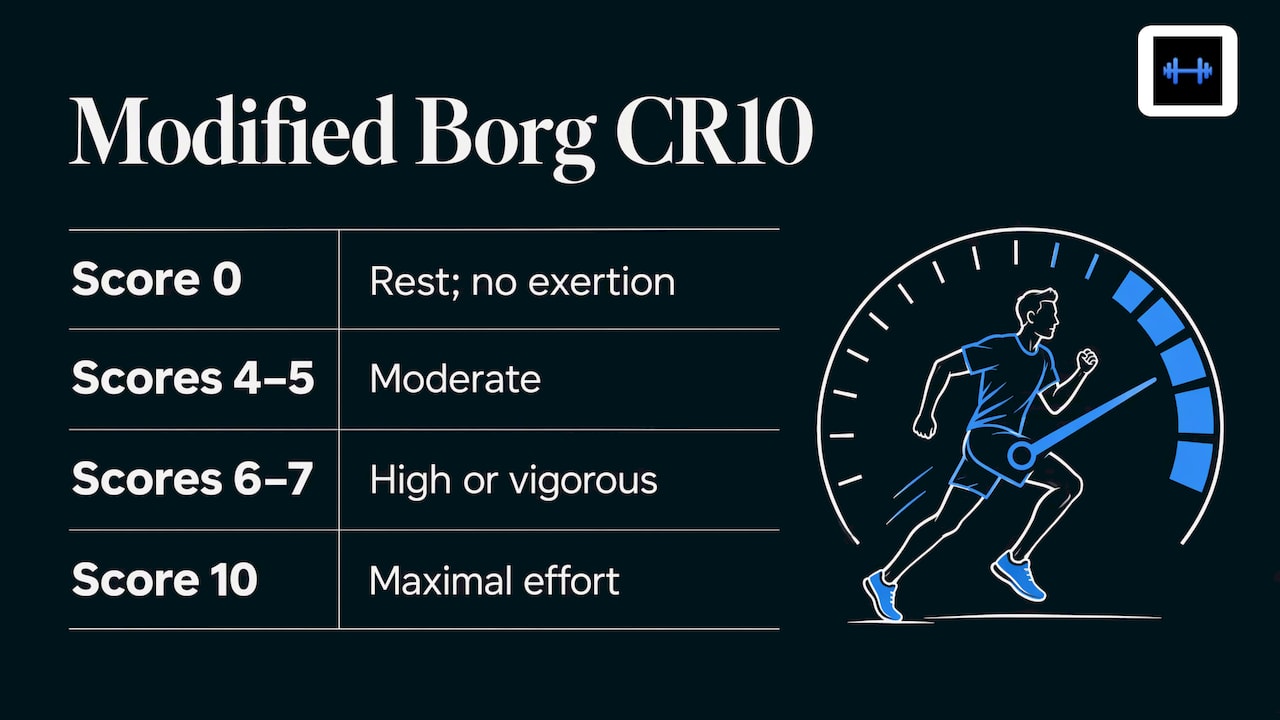
The modified Borg CR10 scale runs from 0 (rest, no exertion) to 10 (maximal effort). In Cleveland Clinic's guide, 4 to 5 is moderate and 6 to 7 is high or vigorous. Most people find it easier to use because the numbers are familiar.
A 2021 comparison study by Hutchinson and colleagues found a strong association between scores on the 6 to 20 and 0 to 10 scales. You can use either, as long as you stay with one.
Which scale should you use?
- Cardio and heart-rate work: the Borg 6 to 20 scale.
- Bodybuilding and muscle building: the 0 to 10 scale. Cleveland Clinic points to the modified scale for this.
- Lifting with a coach's program: the 0 to 10 scale tied to reps in reserve, covered next.
Whatever you pick, write it down in the program so everyone means the same thing by a "7."
RPE for strength training: tying the number to reps in reserve
In the gym, a vague feeling is hard to act on. The resistance-training scale published by Zourdos and colleagues in 2016 solves that by anchoring each number to how many reps you could still have done. This is called reps in reserve, or RIR. Their mapping is RPE 10 for maximum effort, 9 for one rep remaining, 8 for two, 7 for three, and 5 to 6 for four to six remaining.
| RPE | Reps left in the tank | How it feels |
|---|---|---|
| 10 | 0 | Max effort, no more reps possible |
| 9 | 1 | One more rep, maybe |
| 8 | 2 | Hard, but under control |
| 7 | 3 | Fast bar speed, work is real |
| 5 to 6 | 4 to 6 | Moderate, warm-up territory |
| 3 to 4 | Light effort | |
| 1 to 2 | Little to no effort |
So what does RPE 7 mean in the gym? It means you finish the set with about three good reps still available. If you want a deeper look at the rep-counting side, our guide to reps in reserve training covers it step by step.
A worked example
Say your program calls for 3 sets of 8 on the bench press at RPE 8. That means each set should end with about two reps left.
- Warm up, then load a weight you think you can lift for 8.
- Do the set. If you finish and feel you could have done 4 more, the load was too light for an RPE 8. Add weight.
- If rep 8 was a grind with nothing left, you hit RPE 10. Drop the weight a little for the next set.
- Log the weight, reps and RPE, so next week you know where to start.
This is how RPE replaces fixed percentages. A MASS Research Review guide gives the example of swapping 4 sets of 8 at 70% for 4 sets of 8 at RPE 6 to 8, choosing a load that lands in that range. The same guide notes the load can shift with your daily readiness: heavier on a great day, lighter after a bad night of sleep.
How to determine your RPE in the moment
A simple routine works for most people:
- Check your breathing. Mayo Clinic describes moderate effort as quicker breathing without being out of breath, with light sweating after about 10 minutes as a clue. In cardio, a talk test is a good first filter.
- Check your muscles. In lifting, ask how many clean reps remain, not how much it burns.
- Pick a number right after the set. Do not wait until the end of the workout, when memory blurs.
- Be honest about form. A rep that breaks down does not count as a rep in reserve. Rate the last good rep.
For the whole session, the Ontario weightlifting association's guide describes session RPE: record it within 30 minutes after training and multiply it by the session length to estimate training load in arbitrary units. A 60-minute session rated 7 gives 420 units. Compare that figure across weeks rather than reading it on its own.
Getting better at rating effort
New lifters often rate too low, and accuracy improves with practice. The MASS guide cites research in which trained lifters were, on average, 5.15 ± 2.92 reps off when estimating reps in reserve during a squat set at 70% of their one-rep max. High-rep sets are the hardest to judge. Sets of 3 to 6 reps, closer to your limit, are easier to rate.
Some habits help you calibrate:
- Use heavier, lower-rep sets to learn the scale. The last reps are more obvious there.
- Go to true failure once in a while on a safe movement, such as a machine exercise, so you know what 10 feels like. Use a spotter or safe equipment for any free-weight set.
- Review the descriptors. Camozzi recommends teaching and checking understanding of the scale wording, since beginners and young athletes can find it hard to tell effort levels apart.
- Treat the number as a guide. Olympiatoppen's 2024 intensity-scale document advises using zones as guidance rather than rigid prescriptions, adapted to the sport and the individual.
Cleveland Clinic gives a simple adjustment rule: raise the intensity when sensations feel very light, lower it when effort feels excessive, and hold it when it matches the plan. If you have a heart condition or take medication that affects your heart rate, talk with your doctor before you set intensity targets, since heart rate may not track effort the usual way.
Why RPE works well in a coached program
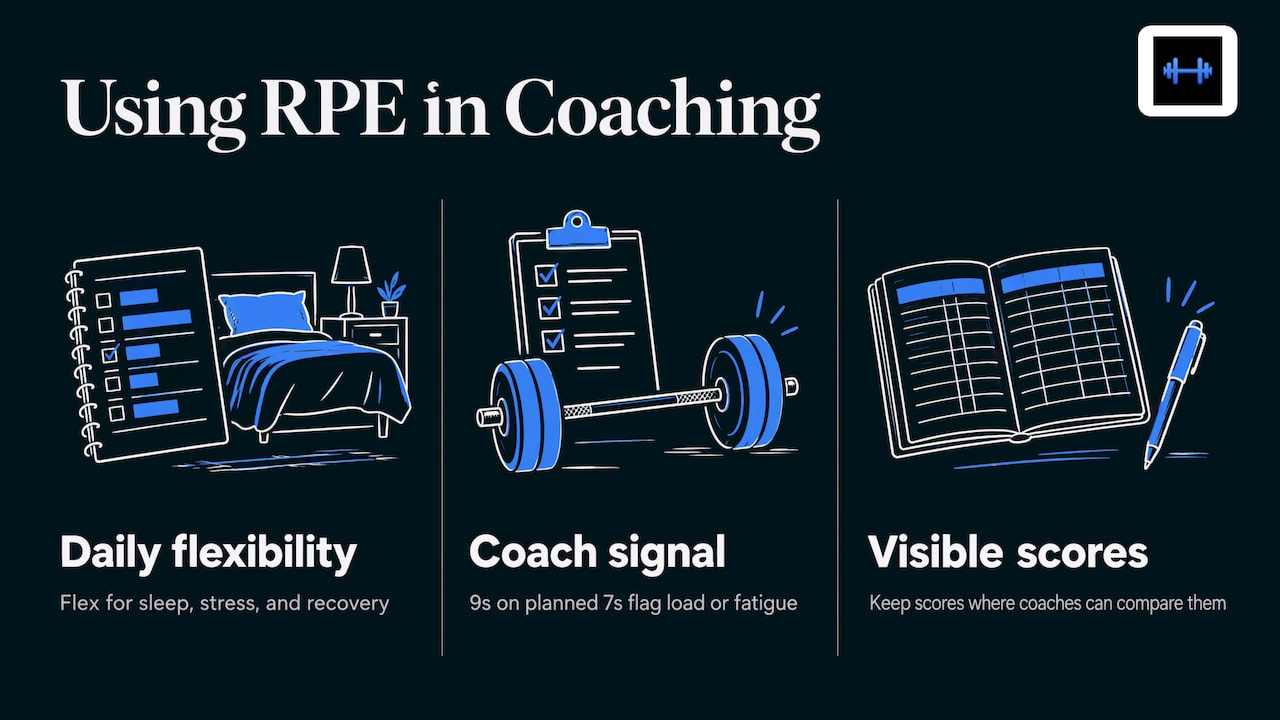
RPE adds flexibility without equipment. A fixed percentage assumes every day is the same. RPE lets the plan flex with sleep, stress and recovery while still telling you how close to failure to work. For a coach, the score is also a message: an athlete who reports 9s on a set programmed at 7 is telling you something about load, fatigue or technique.
That only helps if the numbers are captured where you can see them. Scores sent by text, scribbled in a notebook or tucked into a spreadsheet tab are easy to lose and hard to compare. Our write-up on building an athletic performance program shows where intensity targets fit in the larger plan.
Tracking RPE in GymCoach
GymCoach is a web and iPhone coaching app that puts programs, workout logs and coach-athlete messages in one place. It includes set tracking with RPE and rest timers, progress charts, check-ins and an exercise library, and it syncs with Apple Health or Health Connect.

If you are an athlete, the app is free: you can follow a program, log each set with an RPE and watch your progress over time. You can also train with friends and compare on leaderboards, which makes honest, consistent logging easier to stick with.
If you coach, you can build a program with an RPE target on each exercise, assign it, and read your athletes' logged scores and check-ins without chasing them across group chats. Paid coach plans are priced by roster size: Starter is €19 per month, Pro is €39, Business is €59 and Unlimited is €79, each per month.
Common mistakes with the RPE scale
- Mixing scales. A 7 on the 6 to 20 scale is very light. A 7 on the 0 to 10 scale is hard. Name the scale in the program.
- Rating the wrong thing. Rate the set, not your mood or how much you dislike the exercise.
- Counting ugly reps. If form breaks, the set ended earlier than it felt.
- Never logging it. An RPE you do not record cannot guide next week's load.
- Expecting precision. It is an estimate that gets sharper with practice, which is the point of keeping a log.
FAQ
What is the Borg RPE scale?
It is the original exertion scale, running from 6 (no exertion) to 20 (maximal exertion). It was built to track heart rate roughly in a straight line. It is mostly used for cardio and general exercise intensity.
Why does the RPE scale go from 6 to 20?
Borg wanted the rating to be about one-tenth of your heart rate during exercise. A 6 corresponds to about 60 beats per minute at rest, and 20 to about 200 at maximum effort. That is why you can add a zero to a rating to get an approximate heart rate.
What does RPE 7 mean in the gym?
On the 0 to 10 strength scale, RPE 7 means you finished the set with about three reps still in reserve. It feels challenging but fast and controlled. On the Borg 6 to 20 scale, a 7 would instead mean extremely light effort, so check which scale your program uses.
How do I determine my RPE during a workout?
Rate the whole-body effort right after the set or during steady cardio. In lifting, ask how many good reps you had left. In cardio, use breathing and the talk test. Write the number down every time so you can compare it from week to week.
Can I use RPE instead of percentages?
Yes. You choose a load that puts your planned sets and reps in the target RPE range, then adjust for how you feel that day. Many lifters use both: a percentage for the starting point and RPE to fine-tune it.
Sources
- Rate of Perceived Exertion (RPE) Scale, Cleveland Clinic
- Exercise intensity: How to measure it, Mayo Clinic
- Perceived Exertion as a Function of Exercise Intensity, CDC
- Borg rating of perceived exertion scale, HealthLink BC
- Perceived Exertion Scale for Resistance Training, Zourdos et al. (2016)
- RPE and RIR: The Complete Guide, MASS Research Review
- Rate of Perceived Exertion Versus Repetitions in Reserve, Camozzi (2021)
- Comparison of two Borg exertion scales, Hutchinson et al. (2021)
- Olympiatoppen's intensity scale 2024