

Periodization means planning how your training changes over weeks and months, instead of repeating the same sets and reps until progress stalls. You decide in advance how volume (total work), intensity (how heavy or how hard) and exercise choice shift across phases, then you adjust the plan using what your logs and recovery tell you. The plan only works if it is written down, followed and reviewed, and that is where one app holding the program, the logs and the feedback saves coaches and athletes a lot of friction.
This guide covers what the terms mean, how the main models differ, what the research supports, and how to build a periodized plan step by step, whether you train yourself, with friends, or coach a roster of clients.
TL;DR
- Periodization is the planned variation of volume, intensity and exercises over time, with recovery built in.
- The three layers are the macrocycle (the whole plan), mesocycles (phases of a few weeks) and microcycles (usually one week).
- Linear, undulating and block models all produce strength gains. Research supports planned variation more than any single "best" template.
- Start simple: a 12-week plan, a 3-weeks-up, 1-week-down pattern, and effort ratings (RPE or reps in reserve) to adjust loads.
- Log everything. A plan you cannot review against real numbers is a guess.
Table of Contents
- What periodization actually is
- The three layers: macrocycle, mesocycle, microcycle
- Types of strength training periodization
- What research says about which model works
- How to periodize strength training, step by step
- Planning deloads and recovery
- When results do not match the plan
- Periodizing for several clients or training partners
- Run your periodized plan in GymCoach
- FAQ
- Sources
What periodization actually is
A widely cited 2021 review defines periodization as a logical, sequential method of manipulating fitness and recovery phases to raise the chance of reaching a specific performance goal while limiting overreaching that does not help, overtraining and injury. The same review separates two ideas people often blur together. Periodization organizes the timeline and the phases. Programming covers the details inside them: exercise selection, sets, reps, rest and intensity.
So "linear periodization" is not a program. It is a way of arranging a program over time. You still have to choose the lifts, the weekly frequency and the loads.
Why bother? Because the body adapts to a stimulus and then stops responding to it. Raising the challenge gradually (progressive overload) is the engine of strength. Periodization is how you keep raising it without piling on fatigue forever.
The three layers: macrocycle, mesocycle, microcycle
Periodized plans are built in nested blocks. Review authors describe macrocycles, mesocycles and microcycles whose length depends on the athlete's goals and competition schedule.
- Macrocycle: the whole plan, from a few months to a full year. Example: a 16-week build toward a meet, or a 12-week strength block.
- Mesocycle: a phase inside the macrocycle with one main emphasis, often 3 to 6 weeks. Example: a hypertrophy phase, then a strength phase.
- Microcycle: usually one training week, the unit you actually schedule: which lifts on which days, at what loads.
Sports teams often organize a year around off-season, preparation, pre-season, competition and transition phases. A 2025 study of rugby league athletes used exactly that structure, with mesocycles stressing qualities like strength and power. You do not need a competition calendar to borrow the logic. A recreational lifter can run the same idea with a simple cycle: build, push, test, recover.
Types of strength training periodization
The research describes two main families: traditional and block periodization. Traditional plans come in several forms, and the undulating form is the one most lifters meet in practice.
Linear (traditional) periodization
Linear plans start with higher volume and lower intensity and move toward lower volume and higher intensity. A 2011 review notes these plans often run several months, with phases of roughly 4 to 6 weeks.
A simple version: weeks 1 to 4 at 4 sets of 10 with moderate loads, weeks 5 to 8 at 4 sets of 6, weeks 9 to 12 at 5 sets of 3 with heavy loads. Each phase prepares you for the next. It suits beginners and anyone who likes predictable progress.
Undulating periodization
Undulating plans change the rep and load zone more often. In daily undulating periodization, the same review explains, each session uses a different zone. One example rotates 4 to 6, 8 to 10 and 12 to 15 repetition-maximum zones across three weekly workouts.
A week might look like this: Monday heavy (5 reps), Wednesday moderate (10 reps), Friday light and fast (3 sets of 3 at lighter weight with crisp technique). It suits people who get bored, train three or more days a week, or want to practice several qualities at once.
Block periodization
Block periodization concentrates on one or two qualities at a time and keeps the others ticking over with maintenance work. A 2015 applied account describes the idea as developing one quality, retaining others with minimal work, and using the residual effects to prepare the next emphasis. It is aimed at advanced athletes preparing for a specific date, such as a competition.
How the three compare
| Model | How it changes | Best for | Typical structure |
|---|---|---|---|
| Linear | Volume falls and intensity rises phase by phase | Beginners, first structured program | 4 to 6 week phases over several months |
| Undulating | Rep and load zones change session to session or week to week | Intermediate lifters, variety seekers | 3 different session types per week |
| Block | One main quality per block, others maintained | Advanced athletes with a target date | Accumulate, then intensify, then peak |
What research says about which model works
The honest summary: planning beats not planning, and the model matters less than you would expect.
- Meta-analyses report that periodized resistance training beats non-periodized training for maximal strength, while results comparing linear and undulating plans are mixed.
- A 2015 systematic review and meta-analysis of 17 studies and 510 participants found that 16 studies showed significant strength gains with both linear and undulating training, and no difference between models for upper- or lower-body strength.
- For muscle size, a 2019 mini-review found linear and undulating plans appear similarly effective in untrained people.
- A 2012 review argues the evidence supports planned variation rather than one universally best template.
The practical takeaway is to pick the model you will actually follow, then spend your effort on consistency, sensible progression and recovery. A model that fits your schedule and that you log faithfully beats a clever one you abandon in week three.
How to periodize strength training, step by step
Here is the routine, with where each step tends to go wrong and how coaches and athletes using GymCoach handle it.
Step 1: Set one clear goal and a time frame
Pick a single priority: a heavier squat, a first pull-up, a meet in 16 weeks, or general strength over the next 12 weeks. Two or three competing goals blur the plan. Length follows the goal: the durations vary with the athlete's goals and competition schedule.
Where it goes wrong: vague goals ("get stronger") give you nothing to review. Attach a number and a date. For coaches, the intake questions in GymCoach collect goals, experience and constraints from each new client before you write a single set.
Step 2: Match the plan to experience and schedule
A coaching standard published in 2024 expects coaches to assess individual needs, monitor responses and adapt programs, including periodized programs for individuals and groups. Another source on training cycles notes that sequence and length depend on goals, age, training background and physiological needs.
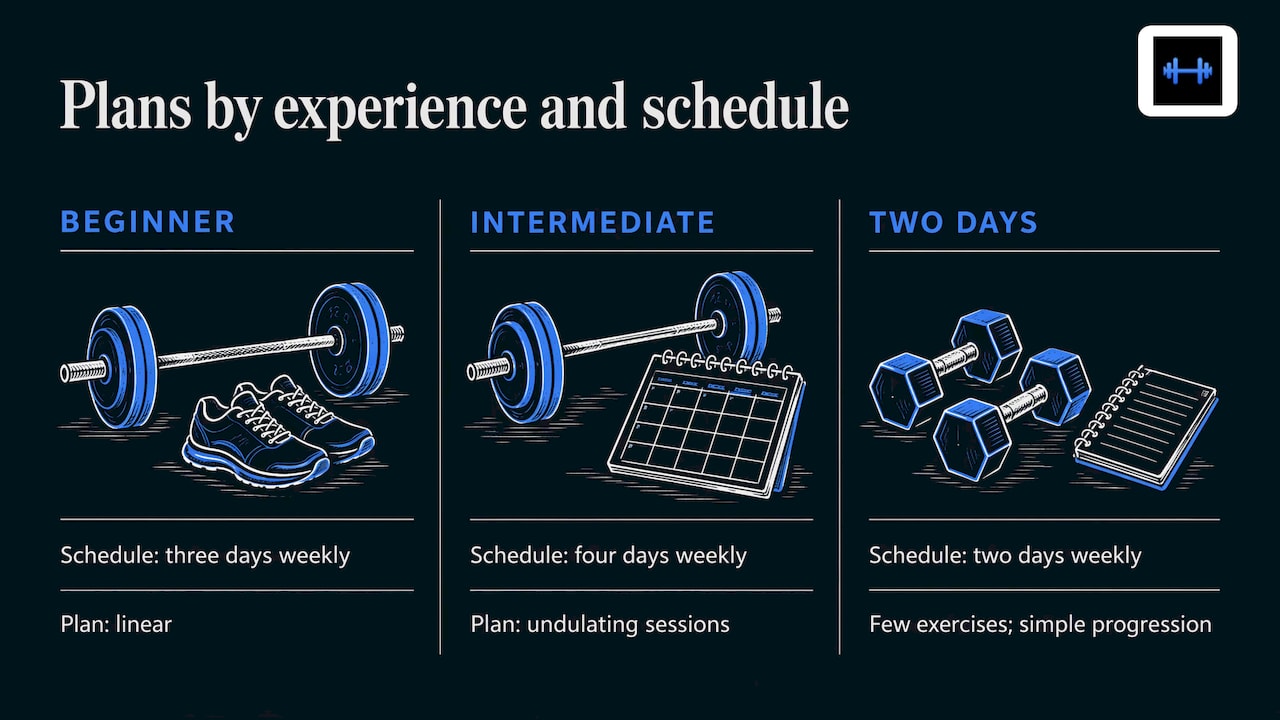
In practice: a beginner training three days a week does well with a linear plan. An intermediate lifter with four days can use undulating sessions. Someone with only two days should keep exercises few and progression simple. Our guide to customizing training programs for any client or athlete goes deeper on fitting a plan to the person.
Novices deserve special care. In a 2025 study of adolescent beginners, the first phase focused on technique, with self-selected loads and sets ended when the athlete felt one or two reps remained, rather than starting with a max test. If you are new to lifting, have a medical condition or are returning from injury, check with your doctor before ramping up intensity.
Step 3: Divide the macrocycle into mesocycles
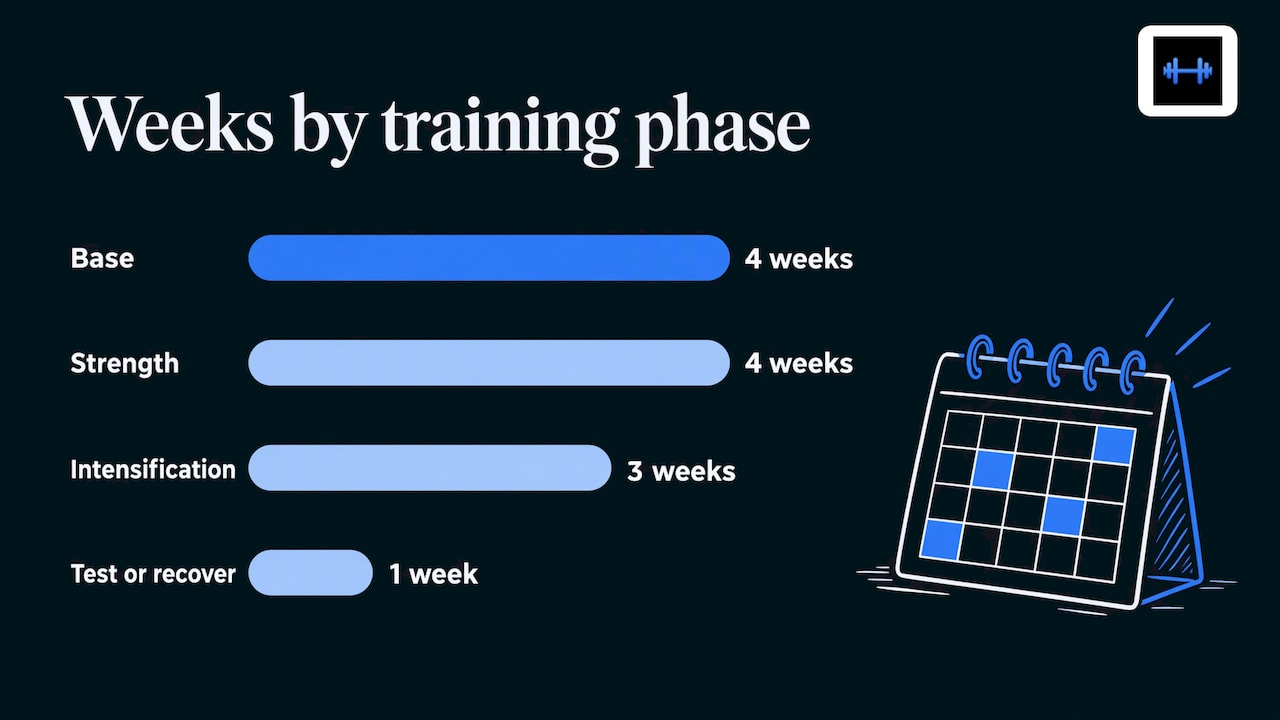
A 12-week example for a general strength goal:
- Weeks 1 to 4, base: 3 to 4 sets of 8 to 10 reps on main lifts, moderate loads, technique focus.
- Weeks 5 to 8, strength: 4 to 5 sets of 4 to 6 reps, heavier loads.
- Weeks 9 to 11, intensification: 3 to 5 sets of 2 to 4 reps, heaviest work, lower total volume.
- Week 12, test or recover: a lighter week, then test or repeat the cycle at higher loads.
This follows the traditional pattern of moving from higher volume and lower intensity toward lower volume and higher intensity. The numbers are an illustration, not a prescription. Adjust to your lifts and recovery.
Where it goes wrong: changing too many variables at once. Keep the main lifts consistent within a phase so the numbers stay comparable. In GymCoach, coaches build the program and assign it to each athlete, so every client on the roster sees their own phase in one place instead of in a spreadsheet tab or a chat thread.
Step 4: Write the microcycle
This is the week you actually train. Decide the days, the order of exercises (big lifts first), sets, reps, rest and loads. The same sources list the variables you control: rest, intensity, exercise selection and order, sets, reps and frequency.
One caution on volume: a 2024 recovery review notes that high-volume sessions raise recovery demands, particularly when sets go to failure, and suggests spreading weekly volume across sessions to protect the quality of your priority sessions.
Step 5: Choose how you will progress the load
Two common ways to move up:
- Fixed jumps: add a set amount when you complete all prescribed sets and reps. The 2025 adolescent study, for example, raised loads by 3% to 5% when athletes completed the work.
- Effort-based: choose the load that produces a target effort, using RPE (a 1 to 10 rating of how hard a set felt) or RIR (reps in reserve, how many more reps you could have done). We explain both in our guides to the RPE scale and the RIR workout method.
GymCoach has RPE tracking and rest timers built into the workout, so each set is logged with weight, reps and effort at the moment you finish it.
Step 6: Log, review, adjust
The plan is a hypothesis until the numbers confirm it. Kiely's review recommends an adaptive framework built on monitoring, athlete feedback, trend analysis and regular comparison of projections with actual results, rather than a rigid schedule.
For athletes, that means checking weekly: did my top sets rise, did my effort ratings creep up, did I sleep and recover? For coaches, it means reading every client's logs and check-ins, then changing the next week. Progress charts and check-ins in GymCoach put those trends in front of you, and our guide on how to track client progress shows what to look at.
Planning deloads and recovery
A deload is a period of intentionally reduced training stress. A 2025 practical review says it may lower volume, effort, duration or frequency, so you manage fatigue and arrive ready for later training.
A common pattern is three weeks of progressive loading followed by an unload week, known as a 3/1 pattern. The 2015 applied account gives that example, while cautioning that planned overreaching can cause chronic fatigue if it is excessive or prolonged. Tapers before a competition typically cut volume while holding or slightly raising intensity.
A practical deload: keep your usual exercises, cut sets by roughly a third to a half, and stop each set well short of failure. Our deload week guide walks through how to plan one.
Deloads can be preplanned or autoregulated. The same review describes planned lighter weeks as checkpoints, while autoregulation changes load or volume in response to readiness, fatigue and performance. Use a planned deload as your default and move it earlier if your logs show stalled lifts, rising effort ratings and poor recovery together. Syncing with Apple Health or Health Connect in GymCoach lets you see your training next to sleep and activity data from your phone or watch.
When results do not match the plan
Every plan meets reality. Three signs it needs adjusting: the same weight feels harder each week, you miss reps you hit last cycle, or you dread sessions you used to like.
Autoregulation is the tool. A 2021 meta-analysis of eight studies and 166 athletes, with interventions lasting 5 to 10 weeks, found that autoregulated loading favored maximal strength over fixed loading, while noting the small evidence base. It names approaches that adjust training based on completed reps, perceived effort or bar speed.
The simplest version for most people is RPE or RIR. If the prescribed top set was meant to feel like an 8 and it felt like a 10, drop the load next time or trim a set. If it felt like a 6, add weight. Small, steady changes keep the plan on course without rewriting it.
Periodizing for several clients or training partners
Coaches rarely run one plan for everyone. Different goals, schedules and recovery mean different microcycles, even inside the same macrocycle. The practical approach is to keep a shared structure (for example, a 12-week arc with a deload at the end of week 4, 8 and 12) and individualize loads, frequency and exercise choice.
Training with friends works the same way. Agree on the cycle, let each person pick loads by effort, and compare logs. Friends and leaderboards in GymCoach make the accountability visible, and workout sharing lets partners follow the same session. For a coach whose clients are also chasing performance targets, our guide to athletic performance training shows how to organize the program around the sport.
Run your periodized plan in GymCoach
Periodization depends on seeing your plan, your logs and your feedback in one place. GymCoach is a web and iPhone app that brings program building and assignment, workout and set tracking, RPE and rest timers, progress charts, check-ins and coach-athlete messaging together, instead of group chats and spreadsheets. Athletes use it free, to follow a coach's program, train on their own or train with friends. Coaches pay by roster size: Starter is €19 per month, Pro €39, Business €59 and Unlimited €79. See the plans and pricing to match your roster.

If you coach, the coach features cover roster management and intake questions. If you train for yourself or with friends, the athlete side is where you log your cycle.
FAQ
Which type of periodization is best for beginners?
Linear periodization is the simplest place to start: moderate loads and higher reps first, heavier and fewer reps later. Research found no difference between linear and undulating models for strength gains, so choose the one you will follow consistently. Spend the first weeks on technique.
How long should a periodized strength cycle last?
Phases usually run about 4 to 6 weeks inside plans lasting several months, according to a 2011 review. Twelve weeks is a practical first macrocycle for most lifters. Competitive athletes set length by their event date.
How often should I deload?
Many plans use a 3/1 pattern, three progressive weeks and one lighter week, as described in the 2015 applied account. You can also place deloads at the end of each mesocycle and move one earlier if your logs show fatigue building.
Do I need to periodize if I just want to get stronger?
Meta-analyses report that periodized training beats non-periodized training for maximal strength. A basic plan with changing rep ranges, steady progression and a deload every few weeks already counts as periodization.
Sources
- Periodization and Block Periodization in Sports (2021)
- Non-Linear Periodization for General Fitness & Athletes (2011)
- Periodized Resistance Training for Enhancing Skeletal Muscle Hypertrophy and Strength (2019)
- Systematic Review and Meta-Analysis of Linear and Undulating Periodized Resistance Training (2015)
- The training process: Planning for strength-power training in track and field, Part 2 (2015)
- Quantifying Long-Term Adaptations in Performance Variables (2025)
- What is periodization? Human Kinetics
- Strength and Conditioning Coaching standard, EuropeActive (2024)
- The Importance of Recovery in Resistance Training (2024)
- A Practical Approach to Deloading (2025)
- Auto-Regulation Method vs. Fixed-Loading Method in Maximum Strength Training (2021)
- Periodization Paradigms in the 21st Century (2012)